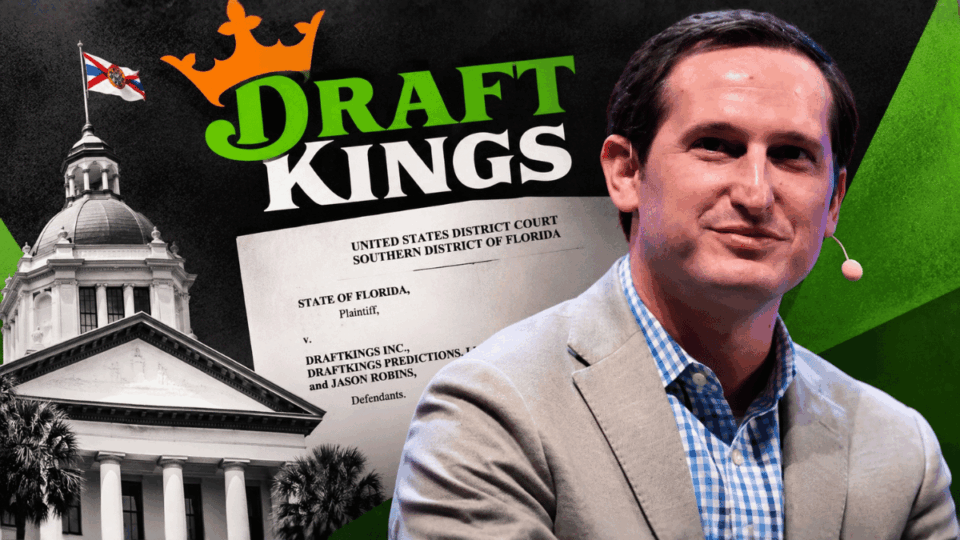
While controlling over 88% of a company’s voting power offers many advantages, DraftKings CEO Jason Robins may soon discover its downsides.
Florida Attorney General James Uthmeier is seeking to hold both Robins and a DraftKings prediction-market subsidiary personally liable, alleging involvement in illegal gambling activities. The proposed lawsuit aims to scrutinize the executive’s own business decisions, rather than merely questioning the legality of the company’s products.
In a 53-page proposed complaint filed on November 24 in the U.S. District Court for the Southern District of Florida—a document reviewed by Gambling Good—Uthmeier’s office alleges that Robins personally directed and approved the launch of four core DraftKings products, which were central to the company’s growth strategy. Florida is seeking consumer restitution, the disgorgement of alleged illicit gains, recovery of lost tax revenue, and civil penalties.
Much of the evidence Florida has used to build its case comes from DraftKings itself. The Attorney General cites a range of company materials, from corporate governance disclosures to earnings calls in which the company celebrated the profitability of its new products.
Following the report, a DraftKings spokesperson provided the following statement to Gambling Good:
“DraftKings’ prediction market offerings are fully compliant with applicable law and the federal regulatory framework established under the Commodity Exchange Act. We are confident in our legal standing and in the services that DraftKings provides in Florida.”
The statement did not specifically address Florida’s attempt to hold Robins personally liable, nor did it mention the financial restitution sought by the Attorney General.
Florida is leveraging Robins’ 88% voting stake to argue for personal liability.
While most litigation involving prediction markets has focused on the jurisdiction of the Commodity Futures Trading Commission (CFTC), Florida’s lawsuit ventures into the realm of corporate governance. Paragraph 14 examines DraftKings’ dual-class share structure, under which Robins—despite holding a significantly smaller percentage of the company’s equity—controls more than 88% of the voting power.
The complaint states: “Robins does not own the DraftKings enterprise; he merely manages it.”
The Attorney General argues that this equity structure grants Robins “effective unilateral control over every major business decision made by the company.”
Florida alleges that Robins has abused his authority by personally approving the launch of products such as Pick6, DraftKings Predictions, the “super app” in Florida, and the recently introduced 21 Rivals—a game similar to blackjack. The state further notes that other shareholders have limited influence over the company’s corporate governance.
Citing a March 2026 proxy statement from DraftKings, the state points out that votes regarding the election of the company’s 11 director nominees, the appointment of its auditors, and executive compensation are effectively guaranteed—”even if any or all shareholders other than Mr. Robins were to vote against them.”
The complaint also notes that DraftKings lacks a lead independent director, and that its Nominating and Corporate Governance Committee has not held a single meeting over the past year. While neither arrangement is inherently illegal, Florida has cited both as grounds for its legal action against the executive.
Robins was previously named in an initial lawsuit filed by the Seminole Tribe of Florida—a move to which DraftKings’ legal counsel has expressed strong objection. In a November 9 notice seeking dismissal, the company characterized the inclusion of Robins as an individual defendant as a “despicable and improper litigation tactic,” pointing to a similar case in California where racketeering allegations against the executive were dismissed.
Nevertheless, the State of Florida is asserting its own statutory rights. Under Section 849.29 of the Florida Statutes, individuals and entities that exercise control over gambling operations may be held jointly and severally liable for recoverable gambling losses. All three counts in the proposed complaint are directed at the three defendants. Should the State of Florida succeed in establishing liability and securing the requested relief, Robins could potentially be held liable for the full extent of any damages—jointly and severally—rather than merely for a proportionate share.
DraftKings faces scrutiny from the State of Florida as its customers lose money at an accelerated rate.
While earnings calls are typically an opportunity to impress shareholders, some of DraftKings’ investor communications have caught the attention of a very different audience. “DraftKings is brazenly offering illegal sports betting services to Florida residents,” the Florida Attorney General alleges in the opening paragraphs of the complaint.
The lawsuit accuses DraftKings of “circumventing Florida law and deceiving consumers.” It cites a business update from the company for the first quarter of 2026, in which Robins acknowledged that customers using its newly launched sports betting service “incurred losses faster than [traditional] sports betting customers.”
Robins further noted that operations in states lacking legal online sports betting have been “one of the fastest-to-profitability business lines for DraftKings to date.” The Attorney General attributes this performance to the fact that DraftKings operates outside of Florida’s regulatory framework for gambling and allegedly targets younger consumers in its marketing.
However, the investor disclosures do not explicitly state that customers in Florida are losing money faster than those in other regions, nor do they suggest that a lack of regulatory protections is the cause of any accelerated losses. The complaint fails to provide a state-by-state breakdown of customer losses to substantiate this claim.
Florida also objects to DraftKings offering its products to individuals as young as 18 and permitting wagers on collegiate sporting events—activities that fall outside the scope of the terms under which the Seminole Tribe is authorized to provide sports betting in Florida.
The State of Florida alleges that DraftKings engages in transactions that run counter to its customers’ interests while collecting fees from them.
DraftKings’ ownership of various components of its predictive market infrastructure has also drawn the attention of the Attorney General. The complaint cites remarks by Jeanine Hightower-Sellitto, Senior Vice President and General Manager of DraftKings Predictions, regarding the establishment of a dedicated market-making division.
Robins has previously emphasized that DraftKings maintains direct control over “three key components of the prediction ecosystem: brokerage, trading, and market-making.” Florida alleges that this arrangement allows the company to profit by acting as the counterparty to its customers’ trades, while simultaneously collecting transaction fees.
The complaint links these allegations to the expectation that profit margins in prediction markets could be 10 to 30 percentage points higher than those in traditional sports betting. Based on its information and belief, Florida argues that—even accounting for the absence of state gambling taxes—such high margins could only be achieved by “directly participating on the opposite side of customer wagers.”
The filing does not provide transaction-level evidence to substantiate this financial theory, and market-making is a standard function within financial exchanges. Mere ownership of a market-making entity does not, in itself, prove that DraftKings is operating a sports betting business.
In its motion to dismiss, DraftKings previously argued that its exchange performs regulatory functions—such as market oversight and enforcement—mandated by the U.S. Commodity Futures Trading Commission (CFTC). Florida, however, contends that the exchange’s infrastructure is insufficient to distinguish its offerings from traditional sports betting.
DraftKings has consolidated revenue from products that are legally required to be treated differently.
DraftKings’ decision to merge its financial reporting has provided Florida with a new line of attack. The complaint cites investor communications from the first quarter of 2026, in which the company acknowledges that its sports betting and prediction market products “serve the same customer base.”
DraftKings announced that it would combine revenue from sports betting and sports predictions into a single figure, explaining that this “best reflects how we plan to operate this business.” The Attorney General also points to comments made by Robins during a Q4 2025 earnings call, in which he admitted that most customers do not understand the distinction between the two services. Florida argues that this “super-app” reinforces its resemblance to licensed sports betting platforms—such as those operated by DraftKings in other states—by presenting sports-related wagering contracts through a similar interface. The complaint notes that the app offers money-line bets, parlay wagers, player incentives, and promotional advertisements, all of which carry the same warnings regarding gambling addiction as those found on platforms from licensed operators.
While combining two revenue streams for reporting purposes does not make them legally identical, it provides a plausible basis for Florida to treat them as a single, unified gambling operation.
Florida Accuses DraftKings of Shifting Legal Risk onto Customers
Perhaps the most troubling contradiction highlighted in the complaint appears within DraftKings’ own terms of use.
“In its fine print, DraftKings acknowledges what it denies publicly: that its operations may violate state gambling laws—and it attempts to shift the resulting legal risk onto consumers in Florida,” the Attorney General alleges.
DraftKings’ “Pick6” terms explicitly state that participation is not guaranteed to be legal in any given jurisdiction. Meanwhile, its “prediction” terms require customers to affirm that their use of the service is legal in their respective locations and to waive certain claims that might arise from potential violations of applicable law.
In short, DraftKings’ terms of use stipulate that the company retains customer funds regardless of the outcome of any potential litigation, while Florida customers are left to bear all adverse legal consequences—along with the associated costs. …the complaint states.
The State of Florida argues that if a customer’s account is frozen or their winnings are withheld—and the underlying contract is deemed void due to violations of state gambling laws—the customer might be left without any legal recourse. Whether the terms of these contracts are legally enforceable, or whether the contracts themselves are unlawful, remains an unresolved issue in this litigation.
Florida questions whether peer-to-peer competition can exempt “21 Rivals” from gambling laws.
On November 10, DraftKings launched “21 Rivals” in Florida via its “super app”—just one day after the company had moved a lawsuit filed by the Seminole Tribe to federal court. Eight days later, Uthmeier publicly questioned the legality of the product.
“But if it looks like a casino, takes real money like a casino, and pays out winnings like a casino—it’s a casino,” the Attorney General wrote on X. “DraftKings will be hearing from us soon.”
The proposed complaint goes further, alleging that “21 Rivals is no different from the games of chance played in Las Vegas casinos.” DraftKings disputes this characterization, maintaining that its customers are competing against one another, rather than against the house. A DraftKings spokesperson told Gambling Good:
“21 Rivals is a skill-based, peer-to-peer competition, and we look forward to engaging in a dialogue with the Attorney General’s office.” A screenshot included on page 26 of the proposed complaint shows that “21 Rivals” is a head-to-head contest in which participants receive the same cards and face the same dealer. The screenshot further indicates that two $1 entry fees result in a $1.80 prize pool, while two $5 entry fees result in a $9 prize pool.
The interface for DraftKings’ “21 Rivals” is depicted in a proposed complaint filed by Florida Attorney General James Uthmeier on November 24, 2026. Image credit: U.S. District Court for the Southern District of Florida.
Florida’s complaint cites a 1991 advisory opinion from the Florida Attorney General’s Office regarding paid-entry fantasy sports contests to support the argument that peer-to-peer competition does not automatically exempt a product from state gambling laws. This interpretation could have implications for other businesses in Florida that offer paid-entry, skill-based contests—regardless of whether they involve prediction markets.
Florida is seeking to recover lost tax revenue and is requesting penalties of up to $15,000 for each qualifying violation. …civil penalties in dollars.
The State of Florida is seeking civil penalties of up to $10,000 for willful violations of consumer protection laws, with the potential for penalties to reach as high as $15,000 if the violations involve consumers over the age of 60, individuals with disabilities, or those with mental or psychological impairments. Furthermore, the state is demanding restitution for lost tax revenue and consumer losses, as well as the disgorgement of any allegedly ill-gotten gains.
DraftKings’ own characterization of the profitability of its prediction markets has been cited in Florida’s tax litigation. The lawsuit references an interview with CNBC in which [Jason] Robins noted that the absence of gambling taxes in Florida was a primary driver for the company’s higher projected profit margins.
The Attorney General alleges that the defendants engaged in business practices designed to “circumvent, evade, or disregard Florida law, defraud Florida residents of their hard-earned money, and steal tax revenue from the state treasury.” Whether DraftKings is liable for these tax obligations remains the central legal question in the case.
Florida has not disclosed the total monetary value of the losses attributed to the defendants, stating only that the “amount subject to equitable disgorgement is expected to be substantial.” Gambling Good has reached out… DraftKings has been asked for comment regarding the claims brought by the Attorney General.
Even if the Seminole Tribe prevails, Florida remains concerned about losing control over the recovery of funds.
Although Florida—like the Seminole Tribe—opposes DraftKings’ operations, the state argues that the Tribe cannot adequately represent the state’s interests. The Tribe’s primary objective is to protect its exclusive right to offer online sports betting, whereas the Attorney General seeks to strengthen the enforcement of consumer protection laws and safeguard state revenue.
Under a 2021 gaming compact, the Tribe agreed to provide at least $2.5 billion in revenue-sharing payments over the first five years of the agreement. Throughout the 30-year term of the compact, subsequent payments are earmarked to support environmental projects, water resource management, and local government affairs.
In its accompanying motion to intervene, Florida argues that a victory for the Tribe could still result in an unfavorable outcome for the state. Florida asserts that without the Attorney General’s intervention, it would be unable to ensure that any recovered funds are distributed in a manner it deems most beneficial to the public.
The Tribe does not oppose the Attorney General’s participation; the deadline to respond to the motion is December 8. Florida also intends to support the Tribe’s forthcoming attempt to remand the case back to state court.
The court has yet to grant Florida’s motion, and none of the allegations have been adjudicated. However, the Attorney General has requested a jury trial—meaning that the business model DraftKings pitched to Wall Street could ultimately be subject to the scrutiny of a jury.