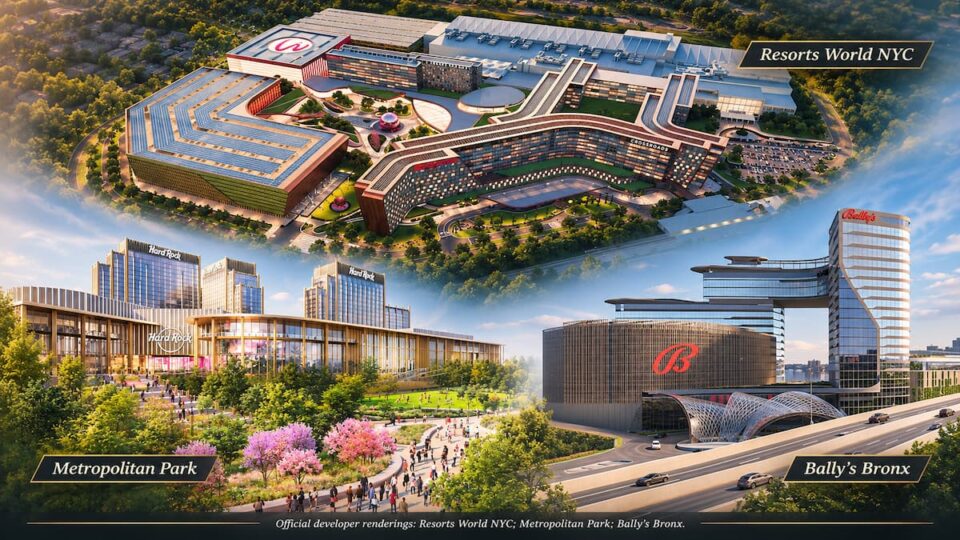
Nearly a year after the awarding of three commercial casino licenses in New York City, the successful bidders are facing a new set of challenges as they strive to deliver their multi-billion-dollar projects.
Resorts World New York City moved quickly to expand its gaming floor and introduce table games in April. However, revenue growth has been modest, and a dispute with the state government over horse-racing subsidy payments has resulted in a bill reportedly totaling as much as $80.6 million.
In Queens, the Hard Rock “Metropolitan Park” project—situated next to the Mets’ stadium—has encountered hurdles in securing design approval from the city. Meanwhile, in the Bronx, Bally’s Corporation has secured initial financing for its proposed casino at Ferry Point, easing some of its financial pressure.
Many of these challenges echo concerns raised by the Gaming Facility Location Board (GFLB) before it recommended these three projects last December.
In its selection report, the board’s consultants projected that the three casinos could generate a combined $5.5 billion in annual gross gaming revenue (GGR) by 2033, and contribute approximately $7 billion in new gaming tax revenue between 2027 and 2036. At the same time, however, the board expressed reservations regarding financing, revenue forecasts, and the ambitious construction timelines.
Resorts World Expands Gaming Floor, Yet Revenue Growth Remains Modest
During the bidding process, Resorts World was widely considered the frontrunner, as it was already an established “racino” (a racetrack with a casino) that had been operating video lottery terminals (VLTs) since 2011, contributing tax revenue to the state.
The developer pledged to rapidly transform the facility into a full-scale casino, officially launching commercial operations—including table games—on April 28. This phase featured 2,500 slot machines and 242 table games. In July, the casino added another 1,400 slot machines, followed in October by the opening of an “International VIP Room,” an exclusive area designed for high-stakes gamblers. However, this expansion has yet to translate into a corresponding increase in revenue.
According to data from the New York State Gaming Commission, Resorts World’s gross gaming revenue (GGR) reached $794.3 million as of October. Since the commencement of full commercial operations in May, monthly revenue has consistently ranged between $122 million and $136 million.
Between May and October, the number of slot machines and electronic table games (ETGs) at Resorts World increased by 61% to 4,024 units. Nevertheless, revenue from these machines fell by 9.5%, with the average daily revenue per unit dropping from $1,275 to $716.
Table games have helped offset the overall downward trend; their monthly revenue has doubled since their introduction, marking a 54% increase since mid-May.
The latest weekly data, current as of November 15, shows that the casino has generated $859.6 million in revenue since its commercial opening, with gaming capacity expanding to 4,137 slot machines and electronic table game units, alongside 345 live gaming tables.
In its casino license application, Resorts World projected that its gross gaming revenue (GGR) would reach $2.2 billion by 2027. Based on current weekly revenue figures, however, that total would be closer to $1.54 billion. Despite plans for further expansion, Resorts World would need to grow its revenue by approximately 44% over its current pace to meet its initial projections.
Resorts World is also facing a tax dispute with the state government.
Revenue performance is critical, as Resorts World relies on operating cash flow to fund subsequent phases of its $5.5 billion integrated resort development.
In July of this year, the company launched the second phase of the project, in addition to expanding its gaming floor. The second phase of the project includes a new hotel tower with 400 guest rooms, an entertainment venue with a capacity of 7,000, a central plaza, and a parking facility.
However, a dispute with the state government over statutory horse racing support payments could complicate the economic viability of the expansion.
According to financial reports from the New York State Gaming Commission, Resorts World owed the state $80.6 million as of October. By June 2027, the disputed amount could exceed $180 million.
As a condition of their licensing, all three casino operators agreed to provide funding to support the struggling horse racing industry. However, since the other two casinos are not scheduled to open until 2030, Resorts World is currently responsible for the full amount—a commitment that will total nearly $500 million by that time.
Resorts World argues that it should be permitted to deduct these payments from its total tax liability; the state, however, disagrees, maintaining that this is a separate, distinct obligation. Under the terms of its winning bid, the company committed to a 56% tax on revenue from slot machines and a 30% tax on revenue from table games.
Resorts World contends that if it is required to pay these racing support funds on top of its existing gaming taxes, its effective tax rate on slot machine revenue would rise to approximately 72%.
An interim agreement reached in October allows Resorts World to make its horse racing support payments directly to the New York Racing Association while negotiations continue. Nevertheless, the State of New York has not waived its right to claim the unpaid amounts.
According to New York Focus, executives at Resorts World have previously indicated that this additional financial burden could jeopardize the planned expansion.
Metropolitan Park faces further delays in design approval.
The $8.1 billion “Metropolitan Park” development—backed by New York Mets owner Steve Cohen and Hard Rock International—continues to face opposition from the local community, even as it seeks a casino license. On Monday, the New York City Public Design Commission (PDC) postponed its vote on the project’s design for the second time in just over a month, as a five-hour-long meeting proved insufficient to hear all public testimony.
The commission had previously tabled the proposal unanimously on October 20, requesting further information regarding stormwater mitigation measures, as well as revisions to the building’s façade, pedestrian circulation, and public access pathways.
The developers subsequently adjusted the proposal, including updates to stormwater management strategies.
The commission’s jurisdiction is limited strictly to architectural design. While it holds no authority over the issuance of casino licenses, it possesses the power—as demonstrated here—to significantly delay the construction timeline.
This latest delay comes at a time when the project is already running behind its original schedule.
In May, the Queens Daily Eagle reported that construction at Metropolitan Park was approximately five and a half months behind the timeline submitted to state regulators.
The developers had initially planned to begin foundation testing in January and casino construction in April. Although preliminary preparatory work has proceeded well, these early milestones have faced delays. At the time, representatives for Metropolitan Park maintained that these setbacks would not affect their target opening date of 2030.
GFLB had previously cautioned that, given the scale of the project and the constraints inherent to urban construction, the proposed opening timeline might be overly optimistic.
Metropolitan Park has been granted another opportunity to move forward, with the PDC scheduled to revisit the proposal on November 30.
Bally’s Advances Pre-Construction Financing for Bronx Casino Project
While Metropolitan Park navigates the design approval process, Bally’s has also been working to secure funding for its own project in the Bronx.
On October 2, the company announced that it had secured $400 million in financing, led by WhiteHawk Capital Partners, to cover pre-construction costs and other related expenses for Bally’s Bronx.
In its third-quarter earnings report, Bally’s confirmed that an additional $160 million remains available for future drawdown. However, these loans carry high interest rates and are set to mature in April 2028—more than two years before the planned opening of the $4 billion development project.
During the licensing approval process, Bally’s financial standing emerged as a point of concern for the Gaming Facility Location Board (GFLB). The board questioned whether Bally’s could guarantee the completion of the project and the fulfillment of its financial obligations.
Bally’s financial health remains a cause for concern. In its recently released third-quarter earnings report, the company issued a warning—for the second consecutive quarter—that it might struggle to meet its debt obligations. It disclosed that, as of the end of September, it had failed to meet minimum liquidity requirements.
Subsequently, Bally’s announced an additional $560 million in financing commitments to bolster its liquidity position; however, questions persist.
The company has made some progress on its Bronx project. In February, it acquired the development site for $157 million, and in July, it submitted an application for construction permits.
Unlike the Metropolitan Park proposal, the redevelopment plan for the northeastern and western sections of Ferry Point Park received preliminary approval from the Public Design Commission (PDC) in October. Furthermore, unlike Metropolitan Park, construction for the Bally’s casino is slated to begin in 2027.
Both of these proposed casinos are still scheduled to open in 2030. The coming year, however, will provide a clearer indication of whether they can meet this timeline. Meanwhile, the performance of Resorts World (Genting) offers an initial glimpse into the revenue potential of the commercial casino market in New York City.