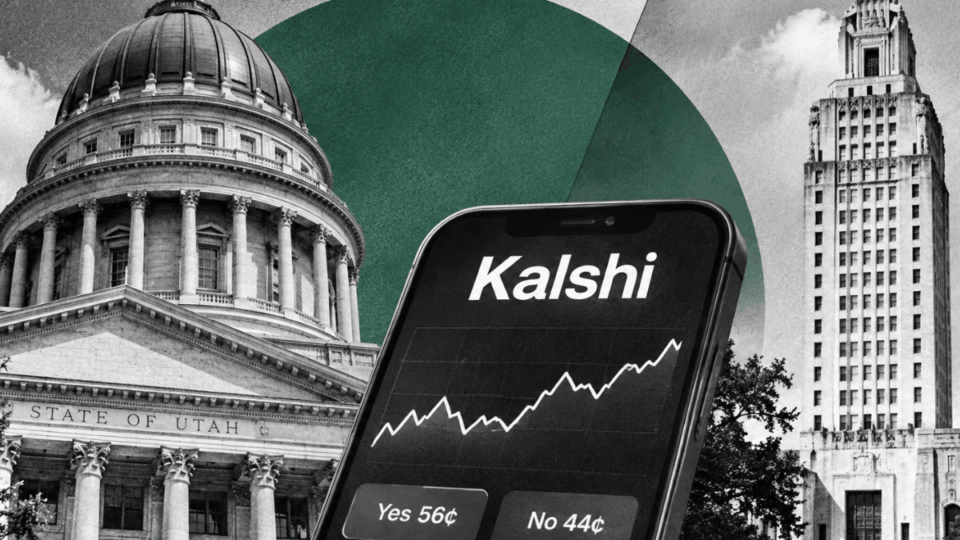
Utah’s decision to prosecute the co-founders of Kalshi has drawn criticism from an individual familiar with the matter, who characterized the move as a “stunt.” The source questioned why prosecutors would pursue criminal charges—and proceed with the case—while the question of jurisdiction over sports prediction markets remains unresolved in the courts.
“Honestly, I think they’re just looking for attention,” the source told Gambling Good on condition of anonymity. “It’s a tactic on their part.”
These criticisms emerge as Kalshi co-founders Tarek Mansour and Luana Lopes Lara prepare to appear in a Utah court. Meanwhile, in Louisiana, Kalshi has withdrawn a separate federal lawsuit, opting instead to join a challenge against state enforcement actions—a move supported by the Commodity Futures Trading Commission (CFTC).
Utah Criminal Case Puts Prosecutorial Judgment Under Scrutiny
In October, Utah Attorney General Derek Brown filed charges against Kalshi and its co-founders, alleging that they illegally offered sports betting contracts to state residents. This followed a federal judge’s ruling in August that declined to block Utah from enforcing its gambling laws against the company.
Mansour and Lopes Lara have retained criminal defense counsel, with their initial court appearance scheduled for December 4. The allegations have yet to be tested at trial. While the source offered no comment on the founders’ personal defense strategies, they expressed clear frustration with the prosecution’s actions.
“Frankly, I think it’s entirely inappropriate,” the source stated.
With appeals still pending in the courts, the source argued that Utah is treating a contested regulatory issue as a criminal matter. The core objection is that the state has chosen to bring charges against individuals before the broader jurisdictional question has been settled. “It is highly inappropriate to label someone a criminal simply because they complied with the explicit requirements of federal regulators and federal law—even if that compliance happens to conflict with state law,” a source stated.
The source’s argument hinges on Kalshi’s status as a federally regulated exchange, though this status does not, in itself, grant immunity from state-level prosecution. The source also expressed criticism regarding the decision-making process behind the charges, implying that political factors may be at play.
“As a lawyer who genuinely wants to believe in these institutions, it is somewhat disheartening to see criminal charges brought in such a highly politicized manner,” the source added.
There is no independent evidence to suggest that Utah’s legal action was motivated by a desire for public attention, and the Attorney General’s office has previously defended its approach to enforcement. Furthermore, a dispute over federal jurisdiction does not automatically preclude criminal liability; such liability depends on the specific legal elements that a prosecutor must prove.
Utah maintains that regulation by the Commodity Futures Trading Commission (CFTC) does not shield a company from state prosecution.
The state’s position is that a federal license does not authorize a business to offer services that the state classifies as illegal gambling. In a previous statement to Gambling Good, the Utah Attorney General’s office asserted that Kalshi remains subject to Utah law, regardless of its registration with the CFTC.
The state contends that contracts based on sporting events constitute gambling, irrespective of the exchange on which they are traded. This argument was bolstered in August, when U.S. District Judge Robert Shelby denied Kalshi’s request for an injunction to block the enforcement of state laws against such contracts.
However, the source suggests that the potential for criminal penalties—which could arise during the appeals process—is the core issue. The source hinted that this jurisdictional conflict could ultimately reach the U.S. Supreme Court.
The source estimates that this could happen within a year, depending on the pace of the appeals. That said, the Supreme Court has not yet agreed to hear the case, and there is no guarantee that it will choose to do so. The U.S. Commodity Futures Trading Commission (CFTC) has also entered the fray, filing a federal lawsuit in connection with the enforcement actions taken in Utah. The agency argues that Congress granted it exclusive jurisdiction over contracts traded on regulated exchanges—a position that could impact restrictions imposed by other states, though it does not necessarily determine the criminal liability of the founders.
Sources indicate that the dismissal of Kalshi’s case in Louisiana was a matter of venue, not a surrender.
Louisiana has taken a broader approach than Utah, targeting multiple prediction market firms rather than focusing solely on individual executives. On November 12, Attorney General Liz Murrill secured an emergency temporary restraining order against Kalshi and other operators, sparking a contentious tug-of-war between state and federal courts.
Five days later, shortly before a scheduled hearing on the injunction, Kalshi voluntarily withdrew its separate federal lawsuit. While this brought that specific case to a close, it left unresolved the question of whether Louisiana has the legal authority to restrict the company’s contracts.
When asked whether Kalshi’s withdrawal altered its legal standing, a source offered a two-word assessment: “Honestly, very little,” the source said.
The source explained that because the same issues were already being litigated before another federal judge, there was no need for parallel proceedings. According to the source, dropping one case does not signify an abandonment of the fight.
Filings made the following day lend some support to this interpretation, though they do not explicitly state the company’s reasons for withdrawing the earlier suit. On November 18, five entities affiliated with Kalshi filed to join the CFTC’s lawsuit against Louisiana as plaintiffs.
Rather than continuing its own litigation in the Western District, Kalshi has opted to align itself with the federal regulator within the proceedings taking place in the Eastern District. Whether the request is granted rests with the court; the court has not yet approved the motion to intervene, which was filed on November 18.
Louisiana could win the battle to have the case remanded without resolving Kalshi’s legal challenge.
Kalshi’s request to intervene follows proceedings overseen by Judge Lance Africk of the U.S. District Court for the Eastern District of Louisiana, who is handling three related matters. These include an enforcement action initiated by the State of Louisiana—which Polymarket has removed to federal court—and a challenge by the Commodity Futures Trading Commission (CFTC) regarding Louisiana’s jurisdiction.
Louisiana seeks to have the enforcement action remanded to state court, while the CFTC aims to prevent the state from applying its gambling restrictions to a federally regulated exchange. Even if Louisiana were to prevail in the first matter, the second issue might remain unresolved.
In a recent interview with Gaming Insider, gaming attorney Daniel Wallach drew a distinction between these matters. He noted that a successful remand would not resolve the separate federal case, nor would it determine whether Louisiana’s gambling laws are preempted by federal law.
The source also dismissed claims that Kalshi has shifted its position regarding sports-related contracts—noting that Kalshi had previously opposed restrictions on markets concerning the 2024 general election. According to the source, critics are conflating the subject matter of the contracts with their legal classification.
“The other side is confusing two entirely different concepts,” the source stated. “They are conflating the subject of the contract—what the contract is about—with the contract itself.”
The source maintains that, from a regulatory perspective, contracts involving sporting events are not necessarily equivalent to sports betting wagers. Rather, they argue that Kalshi’s previous case regarding election-related contracts and the current litigation concerning sports-related contracts are both rooted in the same interpretation of federal law. Congress has granted the Commodity Futures Trading Commission (CFTC) exclusive jurisdiction to determine whether such contracts may be listed. Regardless of the extent to which one might view these contracts as a form of gambling, the intent behind the legislation enacted by Congress was to vest the authority to approve or prohibit the listing of such contracts in the CFTC—not in the individual states.
The State of Louisiana takes a different view, maintaining that federal regulation does not strip states of their authority to regulate gambling. With Kalshi seeking to intervene in the CFTC’s lawsuit, Judge Affric must now address these competing jurisdictional claims.
Gambling Good has reached out to the Offices of the Attorneys General for both Utah and Louisiana for comment. No responses had been received by the time of publication.