A staff advisory issued Tuesday by the agency’s market oversight division notes that, at times, individuals or small groups may be able to manipulate the outcomes of “mention markets”—markets based on whether a specific person uses certain words or phrases in a speech, attends an event, or interacts with others.
The memo points out that most event contracts are tied to independently generated outcomes, such as economic data, election results, or regulated sporting events. “Mention markets,” however, are different, as their settlement depends on “the personal conduct of a specific individual—conduct that may be neither independently generated nor externally verifiable.”
Consequently, staff at the Commodity Futures Trading Commission (CFTC) indicated that they may view “mention markets” as “presumptively susceptible to manipulation.” This implies that exchanges seeking to list such markets may face a higher threshold for approval.
The guidance does not prohibit these types of contracts. Instead, it encourages exchanges to engage with regulators during the “early stages of the design of such contracts” to determine whether there is an elevated risk of manipulation and, if so, whether that risk can be mitigated through appropriate controls.
Less than a month ago, the CFTC ordered Gabriel Perez, a former White House teleprompter operator, to disgorge $107,539.02 in profits, pay a $65,000 civil monetary penalty, and accept a three-year trading ban. The action stemmed from his profitable trading in 39 out of 43 contracts centered on “mentions by President Trump.”
The Daily Telegraph
Liga MX Sues Kalshi for Trademark Infringement
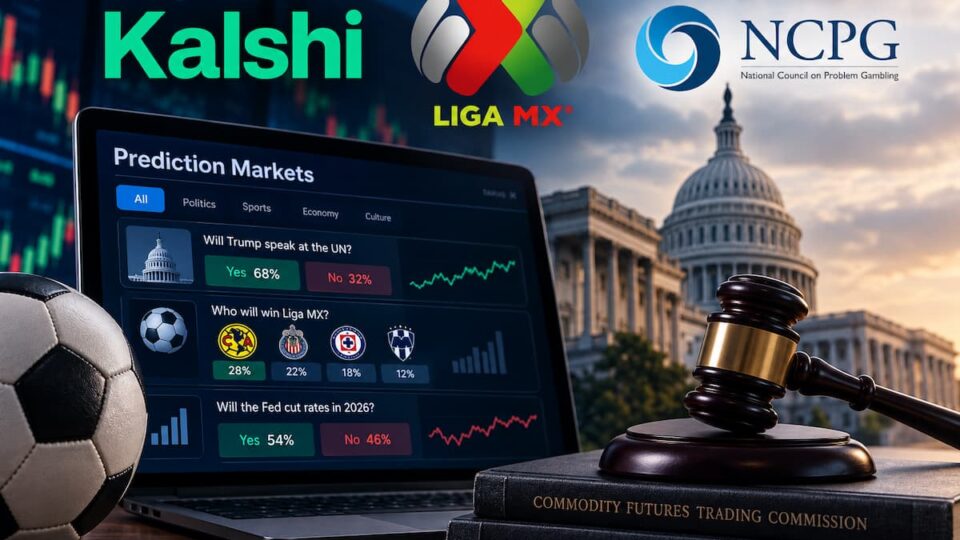
The Mexican Football Federation (FMF) has filed a lawsuit against Kalshi in a New York federal court. The federation alleges that the prediction market operator has improperly used the trademarks of Liga MX—the top tier of the Mexican football league system—as well as the names of its member clubs.
The FMF claims that Kalshi continued to use its word marks even after receiving multiple cease-and-desist notices, although the company has since removed some of the branding. Kalshi argues that its use of the trademark is “limited to plain-text identification within a market regulated by the U.S. Commodity Futures Trading Commission (CFTC),” and denies infringing upon any of FMF’s intellectual property rights.
Latest Developments in Kalshi Litigation: Wisconsin and Tennessee
Kalshi has petitioned the U.S. Court of Appeals for the Seventh Circuit for leave to appeal a ruling from a federal court in Wisconsin. That ruling allows the Ho-Chunk Nation to proceed with claims against the prediction market operator under the Indian Gaming Regulatory Act (IGRA).
The district court previously ruled that the tribe could bring an action against Kalshi under the IGRA. The court also rejected Kalshi’s argument that the Commodity Exchange Act (CEA) or the Unlawful Internet Gambling Enforcement Act (UIGEA) preempts tribal jurisdiction over the activities in question.
Earlier this month, the court certified two questions for interlocutory appeal and stayed the underlying proceedings. Kalshi contends that these questions—which concern the interplay between the IGRA, the CEA, and the UIGEA—are matters of first impression for the Seventh Circuit.
Meanwhile, the State of Tennessee has submitted a Ninth Circuit ruling—in a case brought by two California tribes against Kalshi—to the U.S. Court of Appeals for the Sixth Circuit as supplemental authority in its own litigation against the company. Tennessee argues that this ruling undermines Kalshi’s position that the UIGEA’s treatment of transactions regulated by the CFTC precludes the application of other federal gambling laws.
Senator Calls for Investigation into Matters Including Donald Trump Jr.’s Ties to Prediction Markets
U.S. Representative John Curtis (R-UT) has called on the Senate Judiciary Committee to investigate the business dealings of members of the presidential family. He has requested that the committee subpoena Donald Trump Jr. and Hunter Biden to testify.
Regarding Donald Trump Jr., Curtis pointed to his involvement in cryptocurrency projects, international real estate, and defense investments. Furthermore, the senator noted that Trump Jr. maintains “significant financial and advisory relationships” with prediction market platforms—platforms whose operations depend on favorable regulatory rulings from the U.S. Commodity Futures Trading Commission (CFTC).
Trump Jr. serves as an advisor to Kalshi and Polymarket and holds investments within the sector.
Meanwhile, Curtis has introduced or co-sponsored legislation aimed at banning or restricting certain prediction markets.
The National Council on Problem Gambling (NCPG) has warned that prediction markets are “effectively gambling.”
The NCPG issued a stern warning regarding prediction markets, stating that the industry’s rapid growth is exposing consumers to many of the same risks associated with traditional forms of gambling.
Derek Longmeier, chair of the NCPG board, stated that the organization remains neutral on whether prediction markets should be legalized. However, the NCPG maintains that, regardless of their current legal classification, these markets are inherently a form of gambling.
“These harms are not merely theoretical; we can no longer afford to sit idly by.”
The statement also addressed the NCPG’s funding model, which has drawn criticism for its reliance on industry contributions. While Longmeier acknowledged that many of the organization’s members and donors are gambling operators, he emphasized that “donor involvement does not equate to an endorsement.”
The NCPG asserts that tools for responsible participation—such as self-exclusion options, age verification, risk disclosures, and direct access to support—should be considered the “minimum standard” for any gambling or betting-related product. The organization noted that as prediction platforms increasingly reach young Americans, the necessary protective measures have failed to keep pace.
FanDuel bans bettor featured in CBS report
FanDuel has banned a customer who was mentioned in a CBS News investigation examining sports betting marketing and responsible gambling practices. Esteban Ruiz-Haynes discusses his gambling behavior and his interactions with FanDuel in a report that questions how sportsbooks respond when customers incur mounting losses.
FanDuel subsequently banned Ruiz-Haynes from its platform. The company told CBS News that it has robust safeguards in place to identify problem gamblers.
The operator also disputed broader characterizations of its business practices, calling claims that it fails to actively monitor and address problem gambling “completely false.”
Blumenthal and Tonko Join Campaign for Gambling Reform
Senator Richard Blumenthal (D-CT) and Representative Paul Tonko (D-NY) are set to participate in the launch of the “Truth and Integrity: A Campaign for Gambling Reform” in Washington, D.C., on Wednesday.
The initiative was launched by the Public Health Advocacy Institute and the organization Gamblers’ Families and Friends. It calls on Congress to hold hearings, establish minimum federal safety standards, and strengthen state-level regulation. Organizers stated that the campaign will also focus on the financial ties between the gambling industry and professional sports, collegiate athletics, prediction markets, and technology companies.
The launch event is scheduled for Wednesday afternoon at the Russell Senate Office Building.
Report Estimates Unregulated Online Gambling in the EU at €91.6 Billion
A new study commissioned by the Campaign for Fair Gambling (CFG) estimates that, by 2025, unregulated operators will have generated €91.6 billion ($104.5 billion) in gross online gambling revenue from consumers across the European Union.
The report, produced by Gaming Compliance International, estimates that the unregulated sector accounts for 72% of the EU’s €128 billion online gambling market. It further estimates that unregulated gambling activity has grown by 74% over a two-year period. Kevin Costner Invites Leaders in Gambling and Prediction Markets to a Symposium
Actor Kevin Costner is seeking to convene executives from the gambling industry, tribal organizations, and prediction markets for a private symposium, aiming to foster dialogue regarding growing disagreements over contracts tied to sporting events.
Costner told InGame that he has proposed his Dunbar Ranch in Colorado as a neutral venue for representatives to discuss the matter—an opportunity to “break bread together and see what’s possible.” According to Costner, approximately 70% of those invited have responded to the proposal.
Underdog Partners with Birches Health
Underdog has entered into a partnership with Birches Health to expand its responsible gambling resources and consumer protection measures.
The agreement will integrate Birches Health’s resources—including access to professional treatment and support—into Underdog’s player protection framework. This move comes as Underdog expands its prediction market offerings, a sector where some operators do not provide the same level of responsible gambling tools and safeguards found at regulated sportsbooks.
The U.S. Commodity Futures Trading Commission (CFTC) has raised the bar for entry into prediction markets linked to the statements or actions of public figures, warning exchanges that these increasingly popular contracts may be particularly susceptible to manipulation. Meanwhile, the National Council on Problem Gambling (NCPG) has stated that prediction markets are “gambling, plain and simple.”
Separately, the Mexican Football Federation has filed a lawsuit against Kalshi, and a Utah senator has called for an investigation into the business dealings of the Trump family—including Donald Trump Jr.’s ties to prediction markets.
Breaking News: CFTC Warns of Manipulation Risks in “Event-Based” Prediction Markets
The U.S. Commodity Futures Trading Commission (CFTC) has warned prediction market exchanges that certain “event-based” markets—those tied to specific occurrences or mentions—carry a high risk of manipulation.