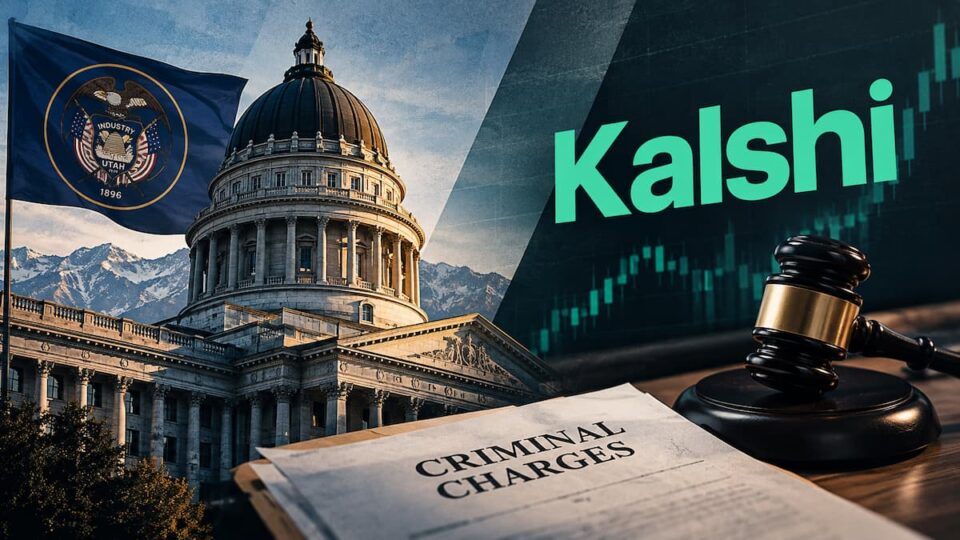
Breaking News: Utah Files Criminal Charges Against Kalshi and Its Founders
The State of Utah has filed 14 criminal charges against Kalshi, naming the company’s co-founders—CEO Tarek Mansour and COO Luana Lopes Lara—as co-defendants, alleging their involvement in illegal gambling activities.
The charges include one second-degree felony count (pattern of unlawful activity), 12 third-degree felony counts (promoting online gambling), and one class A misdemeanor count (promoting gambling).
According to the criminal complaint, an undercover investigator from the Utah Attorney General’s Office created a Kalshi account using a local address, phone number, and debit card. Between September 13 and September 26, the investigator placed 12 wagers—totaling approximately $115—on various sporting events, including NFL games, college football, MLB, MLS, and NHL matches.
Prosecutors allege that Kalshi knowingly accepted wagers from users located in Utah. The indictment asserts that Mansour and Lopes Lara controlled Kalshi and participated in its operations through a pattern of unlawful activity.
The indictment further notes that, despite a summary judgment in Utah’s favor in August and a subsequent denial by the Tenth Circuit Court of Appeals of Kalshi’s motion for an injunction pending appeal, Mansour and Lopes Lara “continued to provide or offer to provide online gambling services to individuals in Utah.”
This follows a civil lawsuit filed by Utah last week, which seeks to halt Kalshi’s operations and recover proceeds allegedly gained through illegal activity. On October 26, the U.S. Commodity Futures Trading Commission (CFTC) and the exchange Crypto.com each filed separate federal lawsuits challenging Utah’s enforcement authority.
The broader legal battle involving the State of Utah continues to escalate. Meanwhile, in the appeal filed by Kalshi with the U.S. Court of Appeals for the Tenth Circuit, several new amicus curiae (friend-of-the-court) briefs were submitted on Wednesday. These included filings from 37 states, the District of Columbia, the Northern Mariana Islands, the American Gaming Association, Better Markets, and various tribal gaming organizations.
Following Arizona’s lead, the state of Utah has initiated criminal charges.
Utah is the second state—after Arizona—to pursue criminal action against Kalshi. The U.S. Commodity Futures Trading Commission (CFTC) challenged Arizona’s enforcement action in federal court, securing a preliminary injunction in May that halted potential prosecutions.
Arizona has appealed to the U.S. Court of Appeals for the Ninth Circuit, seeking to overturn that ruling—a move that follows an August decision by the same appellate court in a case involving Nevada, Kalshi, Robinhood, and Crypto.com.
The Daily Telegraph
A Rutgers University study finds that 43% of adolescents have engaged in gambling over the past year.
A new nationwide study from Rutgers University reveals that 42.7% of Americans aged 13 to 17 have participated in some form of gambling within the last year. Among these adolescent gamblers, approximately 11% are classified as being at high risk for problem gambling.
Researchers surveyed 1,677 Americans between the ages of 13 and 27, finding that 52.5% of the respondents had engaged in gambling over the past year. Nearly one-fifth (18.9%) of those aged 13 to 17 reported gambling at least once a week; individuals in this age group showed a preference for bingo and participating in prize draws or raffles.
Within the 13–27 age cohort, 20.7% participated in sports betting, while 18.4% took part in season-long fantasy sports games. Among emerging activities, 14% of individuals participated in cryptocurrency trading, 12.9% in high-risk stock trading, 8.5% in social casino gaming, 8.3% in esports betting, and 6.6% in prediction markets.
Approximately 40% of those participating in prediction markets and 41% of social casino players are classified as being at high risk of developing a gambling addiction.
The domestic environment also plays a significant role. Among adolescents at high risk of gambling problems, 75.5% reported having a family member who gambles, while 61.2% had gambled alongside a family member.
UK Raises Tax on Slot Machines to 25%, Yet Gambling Stocks Rise
The UK government has announced another increase in gambling taxes: effective April 1, 2027, the Machine Games Duty on high-stakes gambling machines will rise from 20% to 25%.
Chancellor John Healey announced this adjustment in the October 28 budget. It applies to slot machines with stakes exceeding £1 or potential payouts greater than £100. This tax hike follows measures from last year’s budget, which raised the Remote Gaming Duty from 21% to 40% and increased the tax rate on most sports betting profits from 15% to 25%.
This latest increase is significantly smaller than the doubling to 40% that had been widely anticipated—a figure previously suggested by the Social Market Foundation think tank in June.
As expected, stakeholders in the gambling industry reacted negatively. Operators such as Entain indicated that they anticipate a hit to their profits, while others warned that the move could lead to further closures of retail betting shops.
Nevertheless, UK gaming stocks generally rose following the announcement. Shares in Entain and Evoke climbed by 4% to 5%, while the Rank Group saw its share price jump by 10%. MGM, Rush Street Interactive, and Churchill Downs Release Q3 Earnings
The earnings season for the gaming industry continued on Wednesday, with MGM Resorts, Churchill Downs, and Rush Street Interactive reporting their third-quarter results.
MGM Resorts posted consolidated revenue of $4.2 billion, a 1% year-over-year decline. Revenue from Las Vegas Strip operations fell by 2%—driven by lower hotel room rates—while a 5% increase in revenue from MGM China partially offset the decline in domestic operations. Adjusted EBITDA fell to $403 million, down from $506 million in the third quarter of the previous year.
During the earnings call, CEO Bill Hornbuckle stated that acquisition discussions with Barry Diller’s IAC Inc. have concluded, with the two companies reaching a revised voting agreement.
Churchill Downs Incorporated reported third-quarter revenue of $696 million, a 2% year-over-year increase. Adjusted EBITDA rose 1% to $264 million. Additionally, Churchill Downs announced a new $750 million share repurchase program and a 7% increase in its quarterly dividend, signaling a continued commitment to returning capital to shareholders.
Meanwhile, Rush Street Interactive (RSI) delivered strong growth. Revenue climbed 39% to $385.9 million, while adjusted EBITDA surged 73% to $62.2 million. The online gaming operator also reported an all-time high in monthly active users across its North American markets.
On the earnings call, CEO Richard Schwartz expressed optimism regarding the expansion of iGaming in the U.S., highlighting Virginia, Ohio, Indiana, and Washington, D.C., as regions to watch.
Ontario Opens Niagara Falls Casino Market to Three New Operators
The province of Ontario has launched a competitive investment process that could bring up to three new casino operators to the Niagara Falls region. The provincial government and the Ontario Lottery and Gaming Corporation (OLG) announced the plan on Wednesday, which aims to attract over C$3 billion (US$2.14 billion) in direct gaming investment and an additional C$600 million (US$429 million) in private-sector investment over the next 20 years.
Under the plan, experienced casino operators will first submit expressions of interest, after which shortlisted applicants will be invited to propose new, integrated casino developments.
Ontario intends to impose a 9.75% gaming tax on operators in the Niagara region, with the goal of establishing the province’s first competitive land-based gaming market. The government estimates that this expansion could create more than 10,000 construction jobs.
Interested companies must respond to the first phase by December 3.
Polymarket Sues Louisiana Over Restrictions on Prediction Markets
Two days after Kalshi filed a preemptive lawsuit against Louisiana officials, Polymarket has also initiated federal litigation.
The complaint states that “the threat to Polymarket US is imminent and concrete.” It cites an advisory notice issued by the Louisiana Gaming Control Board, which classifies contracts based on sporting events as illegal gambling activities under Louisiana law.
Polymarket argues that the U.S. Commodity Futures Trading Commission (CFTC) holds exclusive jurisdiction over its markets, and that the enforcement actions threatened by Louisiana conflict with the Commodity Exchange Act (CEA). The company also raises a challenge based on a violation of the Commerce Clause.
Sixth Circuit Orders Ohio and Tennessee to Respond to Kalshi’s Petition for Rehearing
The U.S. Court of Appeals for the Sixth Circuit has directed Ohio and Tennessee to respond to a petition for rehearing filed by Kalshi. The petition seeks a review of a September ruling that favored the two states in a dispute concerning prediction markets. As first noted by gambling attorney Daniel Wallach, an order issued on October 28 requires the two states to file responses by November 12. These responses are limited to 3,900 words, and no extensions will be granted.
Kalshi has requested a rehearing—both by the original panel and by the full court—arguing that the appellate court’s ruling (which held that Kalshi’s sports-event contracts do not constitute “swaps” under the Commodity Exchange Act (CEA) and that the CEA does not preempt Ohio’s gambling laws) conflicts with other federal court rulings and recent rulemaking by the Commodity Futures Trading Commission (CFTC).
The NFL has compelled Saquon Barkley to divest his stake in Polymarket.
Philadelphia Eagles runningY back Saquon Barkley revealed that he was forced to sell his shares in Polymarket after the NFL clarified that its restrictions on gambling-related investments also apply to prediction markets.
“I’m not in that anymore, and I’m not allowed to be in that,” Barkley told Front Office Sports.
The NFL previously informed Front Office Sports that players are prohibited from investing in or promoting prediction market platforms, though it declined to comment on Barkley’s specific situation.
This development highlights a stark contrast between the NFL’s approach and that of other major sports organizations.
The NBA recently announced partnerships with Kalshi and Polymarket, while Major League Baseball (MLB), the National Hockey League (NHL), and Major League Soccer (MLS) have also embraced prediction markets through commercial agreements.
Meanwhile, the NFL has consistently refused to enter into similar partnerships. A spokesperson for the NFL Players Association (NFLPA) told Front Office Sports in January that the league “views prediction markets as gambling entities.” Previously, the league urged prediction market operators to remove “objectionable” betting contracts, citing risks to the integrity of the sport. The NFL has also prohibited the use of prediction market contracts related to the Super Bowl and recently urged the U.S. Supreme Court to review the legal status of sports-event contracts.
The conflict between the state of Utah and prediction markets has further escalated, with the state filing criminal charges against Kalshi and its two founders, Tarek Mansour and Luana Lopes Lara. This follows a civil lawsuit filed by the state against Kalshi just days earlier, a matter in which federal regulators have also intervened. Meanwhile, a new study from Rutgers University has revealed concerning gambling trends among adolescents; the UK has announced another hike in gambling taxes; the earnings season for gambling companies is in full swing; and Ontario is preparing to open its Niagara casino market to new operators.