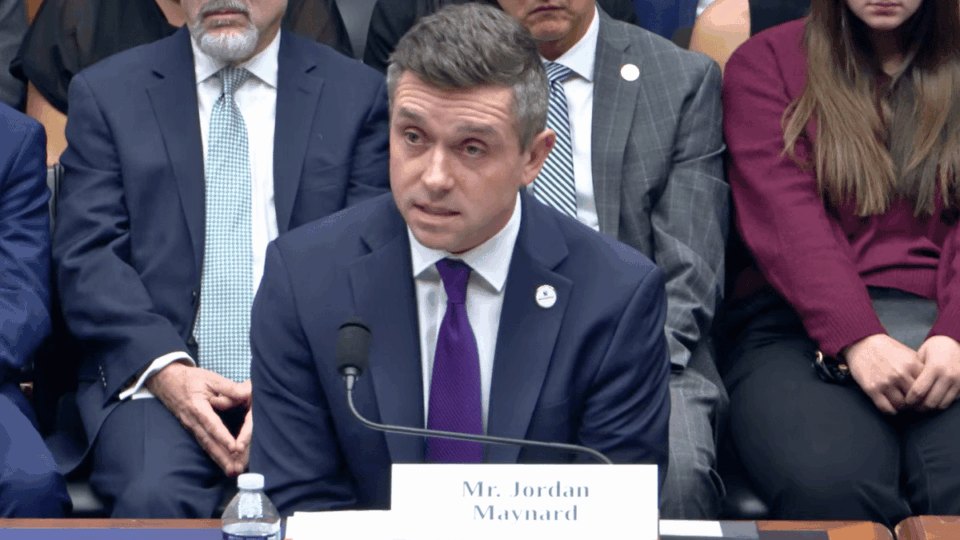
Maynard testified to Congress that, despite Massachusetts’ ban on sports betting, prediction market platforms continue to offer contracts linked to individual college athletes. His objection stems from the fact that products prohibited by Massachusetts sports betting laws can still reach consumers through exchanges governed by federal commodities trading regulations.
When asked by Representative Yasmin Ansari how prediction markets circumvent existing safeguards, Maynard replied: “They offer the same products under different names; they don’t pay taxes, they don’t adhere to regulatory frameworks, and they show no respect for the states and jurisdictions that have already made these policy decisions.”
Age restrictions present a similar discrepancy. While sportsbooks in Massachusetts are limited to customers aged 21 and older, platforms like Kalshi generally allow adults as young as 18 to trade event contracts—including those related to sports.
This creates a unique situation for a 19-year-old: they are too young to legally place a sports bet in Massachusetts, yet—depending on the platform’s policies—they could potentially trade on the outcomes of similar sporting events. Whether such a distinction should exist is part of a broader debate over which legal jurisdiction applies to sports-based prediction markets.
Massachusetts has taken legal action against Kalshi, alleging that its sports-related contracts violate state law and constitute unlicensed gambling. The state secured a preliminary injunction in January 2026, which Kalshi is contesting, arguing that its contracts fall under the purview of federal commodities law.
This legal dispute is far more than a mere disagreement over terminology. Its outcome could determine whether individual states have the authority to enforce sports betting restrictions on exchanges that classify their sports-linked contracts as federally regulated financial products.
While the Massachusetts Gaming Commission (MGC) can provide guidance to consumers, it cannot predict what will happen next. Maynard urged Congress to uphold the jurisdiction of states and tribal nations over sports betting, to prohibit wagering on college athletes, and to invest in independent research regarding the harms associated with gambling. He warned that if similar gambling products were permitted at the federal level, individual states could lose the ability to enforce the protective measures they had specifically incorporated into their own gambling laws.
Kalshi and other prediction market operators reject the notion that their federally regulated event contracts should be classified as conventional sports bets. While the courts continue to weigh the legal arguments, a communication from the Massachusetts Gaming Commission (MGC) raises a more pressing question: where should customers turn for help?
Gambling Good has reached out to both Kalshi and the U.S. Commodity Futures Trading Commission (CFTC) for comment regarding the Commission’s testimony, the handling of consumer disputes, and the protections available to customers of prediction markets.
Currently, the Massachusetts Gaming Commission (MGC) can advise consumers on which federal agency to contact, but it cannot say how those inquiries are ultimately resolved. The Commission’s experience suggests that some consumers are encountering regulatory gaps firsthand, rather than through formal court rulings.
Massachusetts residents have sought assistance from the state’s gaming regulator regarding prediction markets, only to be told they should contact a federal agency. A spokesperson for the Massachusetts Gaming Commission (MGC) told Gambling Good that they have personally handled dozens of inquiries involving platforms that fall outside the Commission’s regulatory jurisdiction.
Previously, Jordan Maynard, Chair of the Massachusetts Gaming Commission (MGC), testified before Congress that consumers have been reaching out to the Commission for help in resolving disputes with operators that operate outside its purview. Maynard noted that part of the problem lies in appearances: to the average consumer, sports prediction markets look very similar to licensed sportsbooks, even though they are governed by different sets of rules.
The spokesperson stated: “Personally, I have seen dozens of such emails arrive in the public inbox monitored by our team. When we receive these, we respond by informing the sender that the MGC does not regulate prediction markets and direct them to contact the CFTC.”
The spokesperson could not immediately provide exact figures, nor could they specify how many of these communications involved actual customer disputes. Gambling Good will update these figures once the Commission provides further information. The response did not identify any specific operators, nor did it clarify whether the Commodity Futures Trading Commission (CFTC) subsequently provided assistance to these consumers.
Customers have asked Massachusetts to intervene in disputes that fall outside its jurisdiction.
This disclosure follows a hearing held on November 11 by the House Subcommittee on Higher Education and Workforce Development, which examined the rise of sports betting on college campuses. In an exchange with Representative Alma Adams, Maynard noted that consumers often struggle to distinguish between state-licensed sportsbooks and “prediction market” platforms that offer similar sports-related products.
“We essentially have two sets of standards for products that appear identical to the end user,” Maynard told the lawmakers. “When users open these apps, they have no way of knowing which one is state-regulated and which one is a so-called prediction market.”
In fact, the Massachusetts Gaming Commission (MGC) frequently receives inquiries from customers asking for intervention in disputes with companies that the commission does not regulate—entities that have not applied for a sports betting license and do not comply with state regulations.
While the inquiries Maynard described may not be identical to those received via the commission’s public email inbox, they collectively indicate that consumers are reaching out to the MGC regarding companies that fall outside its regulatory authority.
It remains unclear what happens next. The commission directs such individuals to the CFTC, but it is not known whether these referrals lead to investigations, refunds, or other forms of assistance.
Licensed sports betting operators in Massachusetts have returned nearly $10 million to customers.
Over the past three years, Massachusetts has developed a regulatory framework for licensed sportsbooks, imposing fines on operators that violate regulations and establishing procedures to rectify errors. According to Maynard’s written testimony, there have been 39 enforcement actions involving fines, with operators paying more than $1 million in penalties to the state.
Furthermore, Maynard’s testimony indicates that licensed operators have returned nearly $10 million to customers as a result of their own operational errors. This figure is particularly relevant to the Massachusetts Gaming Commission’s (MGC) concerns regarding prediction markets: when customers are negatively affected by an operator’s error, the Commission has the authority to require its licensed operators to rectify the mistake.
Maynard argues that the regulatory framework of the U.S. Commodity Futures Trading Commission (CFTC) does not offer the same level of consumer protection for sports betting as that required by Massachusetts. Nevertheless, prediction market exchanges are still subject to federal commodities laws and CFTC oversight; they are not unregulated.
While Massachusetts has documented instances where customers received refunds through the state’s sports betting regulatory framework, the MGC’s data does not indicate whether customers encountering similar issues on prediction markets would fare better or worse.
Conflicts between state and federal law arise regarding bets on individual college athletes and age restrictions.
College sports events serve as another example of rules that, according to Maynard, are being circumvented by prediction markets. In Massachusetts, sportsbooks are prohibited from accepting wagers on individual college athletes—a restriction intended, in part, to shield student-athletes from gambling-related harassment and pressure.