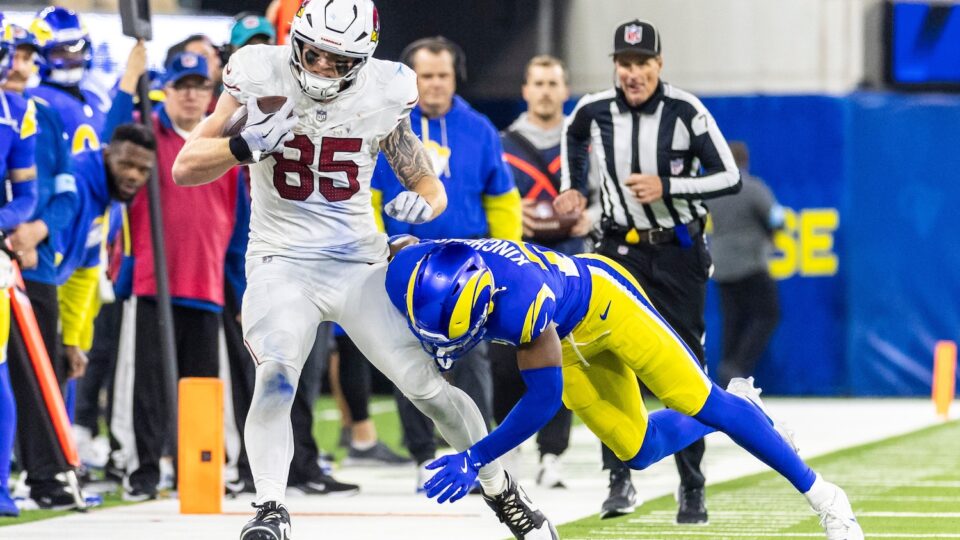
According to public market data from the federally regulated prediction market Kalshi, the platform saw a trading volume of 598,464 contracts betting on Jeremiyah Love to be the third overall pick in the 2026 NFL Draft—a higher volume than for any other player. Nearly three-quarters of this volume occurred on the evening of April 23, the night the Arizona Cardinals selected Love.
Gambling regulators in Arizona and Massachusetts are currently reviewing betting activity linked to Ryan Gold—the Cardinals’ director of scouting—at the sportsbooks they license. Gold has been suspended, with the NFL alleging that he leaked the team’s draft plans.
Kalshi and another prediction market, Polymarket, both offered betting options on this outcome; however, neither platform is licensed by the gambling regulators in these states, and no regulatory body has publicly stated that it is investigating the draft-related trading on these platforms.
On October 8, the NFL argued before the Supreme Court that states should be permitted to regulate such markets. Meanwhile, the Supreme Court has yet to issue a ruling regarding the appeal concerning Gold’s suspension.
How Kalshi’s NFL Draft Prediction Market Works
Kalshi’s “NFL Draft Third Overall Pick” market features individual contracts for 38 different players. If a player is selected third overall, the contract pays out $1; otherwise, it pays nothing. Consequently, the price of a contract (in cents) can be interpreted as the market-implied probability of that player being selected. For instance, a price of 24 cents implies a probability of approximately 24%—though market prices do not necessarily reflect the actual likelihood of an outcome.
A total of 2.3 million contracts were traded across the 38 players. Of these, 598,464 contracts—26% of the total—were for Jeremiyah Love, placing him ahead of Aviel Reese, who saw 528,023 contracts. Gambling Good reviewed all 11,157 individual transactions involving contracts for Love. Since the transaction price for most contracts was well below $1, the total value—calculated by multiplying the reported transaction prices by the number of contracts—amounted to approximately $231,000, according to an analysis by Gambling Good.
On Polymarket, another prediction market that featured this draft pick, contracts for Love saw $36,143 in trading volume—accounting for 26% of the $141,295 total traded across all players for the third overall pick. While this figure is more than six times the volume reported by Polymarket, the two datasets can only be directly compared if both platforms employ the same methodology for calculating trading volume.
The bulk of the trading activity occurred during the final four days.
For most of the three-month period the market was open, trading volume remained low; prior to April 20, there was not a single day where the volume for Love contracts exceeded 10,000 units.
Between March 31 and Sunday, April 19, Love’s contracts traded at an average price of 11 cents, implying a market-estimated probability of approximately 11%.
On Monday, April 20, the price closed at 21 cents; it closed at 24 cents on April 21, and at 32 cents on April 22.
On the afternoon of the draft, the price primarily fluctuated between 31 cents and 46 cents.
In total, 88% of all trades involving Love contracts took place between April 20 and April 23, with 72% occurring on the day of the draft itself. This includes 9% of trades that took place at a price near 99 cents after the draft result had already been announced. On the day of the draft, half of the Love contracts were traded before 8:00 p.m. ET.
The concentration of trading volume as the draft approached indicates a sharp surge in activity as the outcome drew near. However, this does not, in itself, suggest that traders had prior knowledge of the final selection.