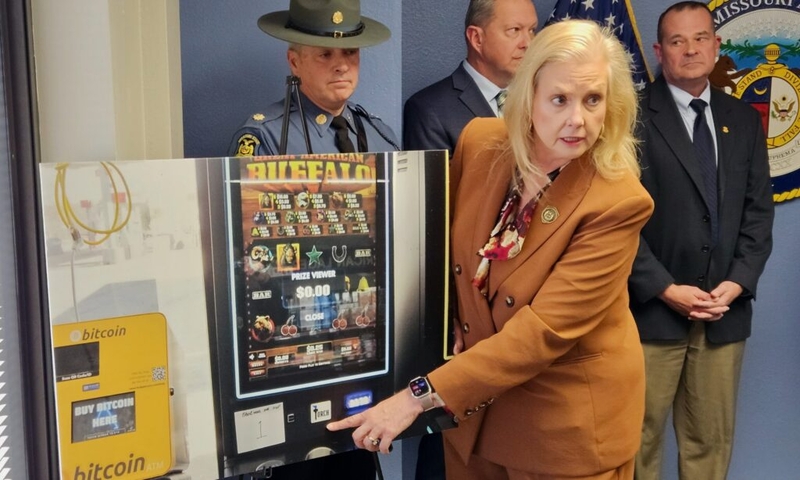
The debate over video lottery terminals (VLTs) has fueled millions of dollars in spending during this year’s legislative elections. State Representative Bill Hardwick, one of the most prominent proponents of VLT-related legislation, won a seat in the State Senate, while Betsy Fogle—a Democrat from Springfield and an outspoken opponent of such legislation—also secured a seat.
Torch Electronics is the largest supplier of these gambling machines, though it is not the only one. Hanaway stated that her office is pressuring other suppliers to shut down their machines and has already begun negotiations with some of them.
“We will absolutely continue to follow up with other companies,” Hanaway said. “We are already in discussions with some of them.”
SPRINGFIELD — Attorney General Catherine Hanaway announced on Monday that Torch Electronics will pay the state $13.5 million over two years and guarantee that its illegal slot-style machines will not be placed in for-profit businesses, in exchange for avoiding state prosecution for violations of gambling laws.
Under the agreement, however, the company may continue to operate its machines at veterans’ halls, fraternal clubs, and other qualifying non-profit venues.
Torch Electronics—the largest supplier of cash-payout games that once proliferated in convenience stores and bars—did not admit that its games violated state laws prohibiting unlicensed gambling. Hanaway noted that the company is also permitted to continue soliciting new non-profit organizations as clients until January 1, 2027.
“This marks a significant step forward in our efforts to root out illegal gambling in Missouri,” Hanaway said. “This is a big deal. It’s a major victory for us, and a major victory for the people of this state.”
Torch Electronics declined to comment on the agreement.
Hanaway announced the deal in Springfield, a city where local officials have spent years attempting to remove Torch’s gaming machines and similar devices. Last October, an appellate court upheld the city’s decision to deny Torch a permit to install gaming machines.
The agreement shields Torch, its owner Steven Miltenberger, and its employees, suppliers, retailers, and others from state prosecution related to their involvement with Torch, provided they adhere to the terms of the agreement.
This week, Torch agreed to pay $4.5 million, followed by an additional $4.5 million annually for the next two years. The agreement stipulates that if Torch violates any of its terms, the company will be liable for an additional $6.5 million payment.
Under federal tax law, these payments are classified as fines, meaning Torch cannot deduct them as business expenses. However, the company has not admitted to any wrongdoing.
“In light of the risk of ongoing and future litigation, Torch is willing to resolve the state’s claims without admitting liability,” the non-prosecution agreement states.
Torch began installing its machines in the years leading up to the COVID-19 pandemic. According to Hanaway, there were 25,000 such machines operating across the state—not all of which belonged to Torch—before she launched a crackdown late last year.
On Monday, Hanaway stated that she could not recall how much money Torch’s machines had generated over the years they were in operation statewide, nor could she specify the amount processed by the machines in March—the last full month before Torch agreed to limit its operations.
Hanaway explained that the $13.5 million settlement figure was reached through negotiations, reduced from the state’s initial demand—which was based on 21% of Torch’s gaming revenue (the same tax rate applied to the adjusted gross receipts of casinos in Missouri). She did not disclose the exact dollar amount of the initial demand.
“It is estimated that the total revenue from all these machines could be as high as $1 billion, though we cannot 100% verify the claimed payouts or other such figures,” Hanaway said.
In April, facing the threat of potential state and federal prosecution, Hanaway pressured Torch to shut down the machines located in retail establishments. Hanaway stated that the shutdown order issued in April did not apply to non-profit organizations, such as veterans’ groups and fraternal clubs. The new agreement maintains this exemption, which she described as a matter of prosecutorial discretion.
“We have to exercise prosecutorial discretion and allocate our resources; we want to target the largest and most harmful operations first,” she said. “Torch is clearly the largest, but it’s also significant that the businesses hosting these machines are pocketing the profits themselves, rather than contributing to the community—unlike veterans’ associations or Elks lodges.”
This exemption applies only to what Hanaway termed “bona fide” non-profit organizations. She emphasized that for-profit businesses cannot qualify for the exemption simply by restructuring as non-profits or establishing non-profit affiliates.
The St. Louis Post-Dispatch reported last month that some businesses had resumed operating their “Torch” machines after forming new legal entities.
Hanaway noted that Torch insisted on retaining the exemption.
“Reaching an agreement like this is difficult,” Hanaway said. “These machines have been shut down for about six months and will not be used moving forward. We wanted to work toward an agreement—and the non-profit organizations themselves will tell you that they have relied on these machines.”
Under the agreement, the “Torch” gaming machines must remain shut down at retail locations unless the company secures a favorable court ruling (upheld on appeal) confirming that its machines do not violate state law, or until the state legislature legalizes such games.
The agreement also provides another potential path for the return of Torch machines to retail locations: should state lawmakers authorize the Missouri Lottery to offer video lottery games, the Torch machines would be permitted to operate during the interim period between the passage of such legislation and the official launch of state-regulated gaming.